
ICF Construction: What Every Custom Home Builder Needs to Know Before They Pour
Straight from the Slab with Duane Holloway · September 27, 2026 · 4 min read
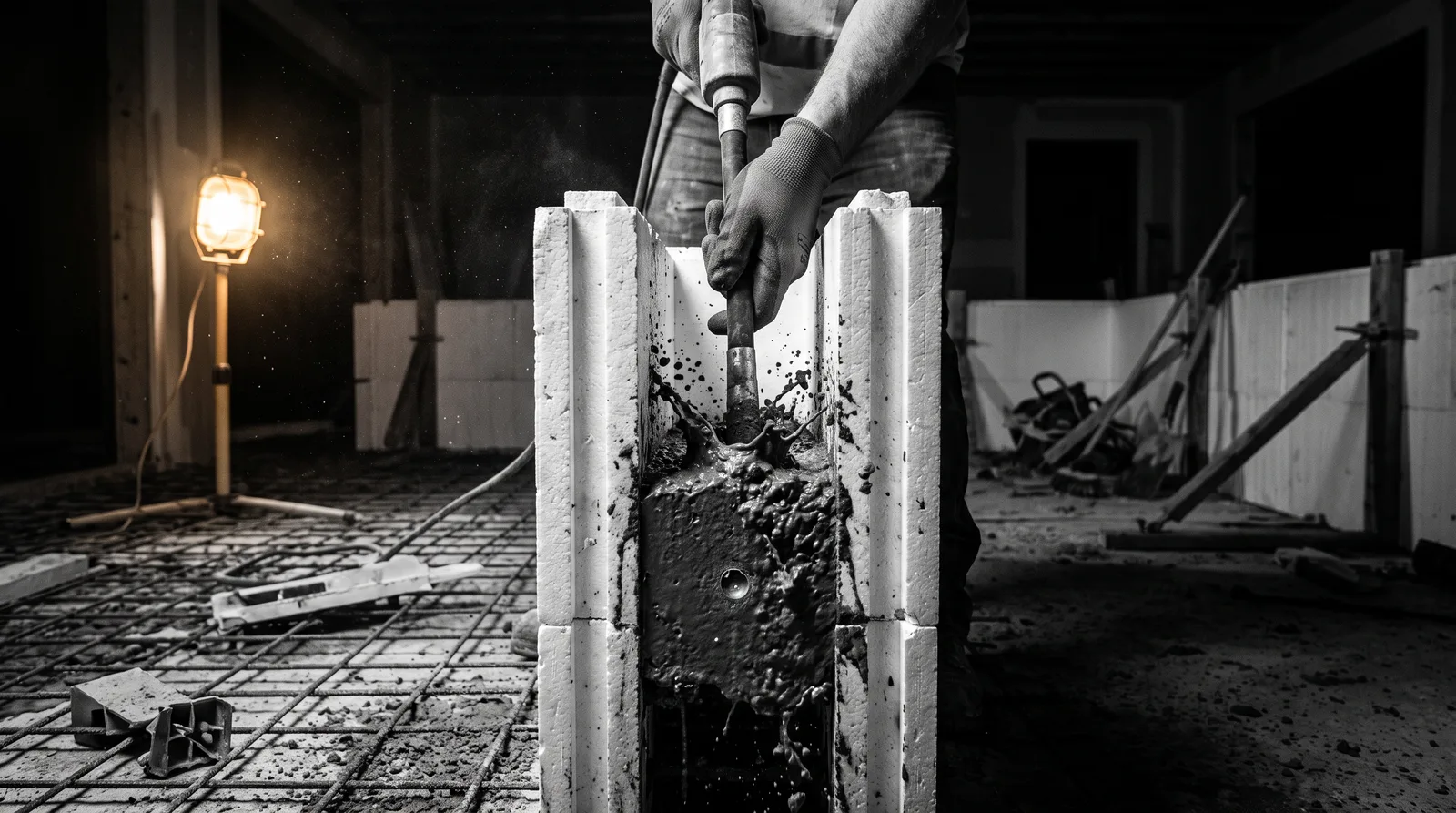
ICF Construction: What Every Custom Home Builder Needs to Know Before They Pour
If you've been researching custom home construction long enough, you've probably come across ICF — insulated concrete forms — and wondered whether it's worth the learning curve. The short answer: yes, if you do it right. The long answer is everything below.
What ICF Actually Is (and Isn't)
Insulated concrete forms are hollow foam blocks — usually expanded polystyrene — stacked like Lego and filled with reinforced concrete. The foam stays in place permanently, so the wall you end up with is a concrete core sandwiched between two layers of continuous insulation.
That's fundamentally different from a stick-frame wall, where insulation is stuffed between studs that themselves conduct heat. ICF has no thermal bridges. The performance numbers reflect that: wall assemblies regularly hit R-22 to R-30 without any additional insulation.
But ICF isn't magic. It's a system, and like any system, the result depends on how well every trade executes.
Why Builders Get into Trouble
Most ICF problems aren't material problems — they're sequencing and coordination problems.
Bracing is the first one. Green concrete exerts serious lateral pressure. If your bracing plan isn't engineered for the wall height and pour rate, you will have blowouts. A blowout mid-pour is an expensive, dangerous emergency.
Penetrations are the second. Electrical, plumbing, HVAC, windows, doors — every penetration through the ICF shell needs to be planned before the pour, not discovered after. Cutting into cured ICF is slow and ugly. Planning it in is fast and clean.
Air sealing is the third — and the one that costs homeowners money for decades. ICF gives you a naturally tight envelope, but only if every joint, corner, and transition is detailed correctly. Sloppy transitions at the rim joist, sill plate, or roof-wall connection negate the whole point.
The Rough Cost Premium — and Why It Usually Pays Back
ICF material and labor typically runs 5–10% more than comparable stick frame at the shell stage. Over the life of the home, that premium is usually recovered through energy bills, often within 7–10 years depending on climate and energy costs.
The tighter envelope also means the HVAC system can be smaller — which is its own cost offset at rough-in and a comfort story worth telling buyers.
For a custom home buyer who plans to live in the house for 20+ years, the math usually works. For a spec builder flipping in 12 months, it's a harder sell.
ICF and the Trades Relationship
Here's something the manufacturer's literature won't say plainly: ICF is only as good as your subs' willingness to adapt.
Framers who've never touched it will be slow on the first job. Electricians will grumble about chasing foam. Insulators may show up expecting a conventional cavity. The builder who succeeds with ICF is the one who does the trade education upfront — specs in the bid, a walkthrough before they start, and a clear sequence of work that respects how the system goes together.
What You Should Know Before the First Course Goes Up
Before any block is stacked, you should be able to answer:
- What is the engineered pour rate for this wall height?
- Where are every window and door buck going, and what's the attachment detail?
- How are the electrical runs being chased, and by whom?
- What's the air-sealing spec at every transition?
- How is the roof-to-wall connection being handled?
If any of those are "we'll figure it out on site," that's where the cost overruns come from.
The Inspection Reality
ICF is still unfamiliar to a lot of building departments. Budget extra time for the structural review, have your engineer's drawings ready, and expect the inspector to spend longer on the first visit. This isn't a reason to avoid ICF — it's a reason to factor it into the schedule.
Getting Proficient, Not Just Familiar
Reading about ICF and building with ICF are different things. The details that seem obvious on paper — corner block layout, rebar scheduling, window buck fastening — are the ones that catch first-timers. The builders who come out ahead on their first ICF project are the ones who did the upfront study before the forms were delivered, not the ones who wung it and learned the hard way.
If you're serious about building high-performance custom homes, ICF is one of the most valuable systems to have in your toolkit. The envelope performance, the disaster resistance, the comfort story to buyers — all of it is real. The gap is just in the execution details.
That's exactly what ICF Build Pro covers — the full system, from your first course to final air sealing, taught by someone who has actually built it.